 Color Fun
5 Ways to Use Coloring Pages as a Creative Tool
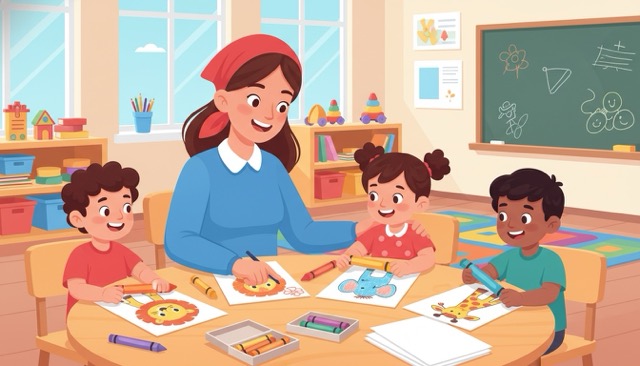
A group of people gathered around a table, each working on their own coloring page, with an atmosphere of focused, collaborative creativity.
The default use of a coloring page is straightforward: here's an outline, fill it in with color. That's a perfectly good activity. But a printed coloring page is also a surprisingly adaptable creative tool, and some of the most interesting sessions come from using it as a starting point for something else entirely.
Here are five approaches worth trying.
**1. Visual journaling without words**
Treat a series of coloring pages as a visual journal. The constraint is simple: choose a page based on how you're feeling, color it in a way that expresses or responds to your current mood, and note the date on the back. Don't analyze it; just do it. Over months, the collection becomes an interesting record — not of events, but of emotional texture and creative instinct.
The value isn't in any individual page. It's in the pattern that emerges across many sessions.
**2. Color-rule constraints**
Before you start, impose a constraint. Only three colors for the entire page. Only cool colors in the background, warm colors in the foreground. Fill every area using a different technique — hatching, stippling, solid fill, blending — and no area can use the same technique twice.
Constraints are one of the most reliable tools for producing interesting creative work. They force choices you wouldn't otherwise make, and those choices are often more revealing and more visually compelling than the unconstrained default.
**3. The same page, twice**
Generate the same image — or a very similar one — and color it twice: once aiming for realism or accuracy, and once aiming purely for emotional expressiveness or visual interest. Compare the two results.
This exercise makes visible the gap between "correct" and "interesting," and most people find that gap genuinely illuminating. The "interesting" version is almost always the one you'd show someone.
**4. Collaborative round-robin**
In a group setting: everyone starts with their own page. After a set time — five minutes, ten minutes — everyone passes their page to the person on their left and picks up where that person left off. Continue until each page has been through several hands.
The results are unpredictable and often more interesting than anything a single person would have produced. The conversation that follows — about what each person chose to do with someone else's in-progress work — is usually the most interesting part.
**5. Generate, then write**
Start with the coloring page rather than ending with it. Generate an image using Color Fun, color it, then write a short text in response — a description, a story, a scene, a few lines of reflection. The colored image becomes a visual anchor for the writing, and the writing deepens your relationship to the image.
This is a particularly useful exercise for people who find writing difficult when starting from nothing. The image removes the blank page problem entirely.
Color Fun generates pages for any theme and complexity level. Start exploring at https://colorfun.app/ — the Dinosaurs category is particularly good for unusual prompts: https://colorfun.app/dinosaurs